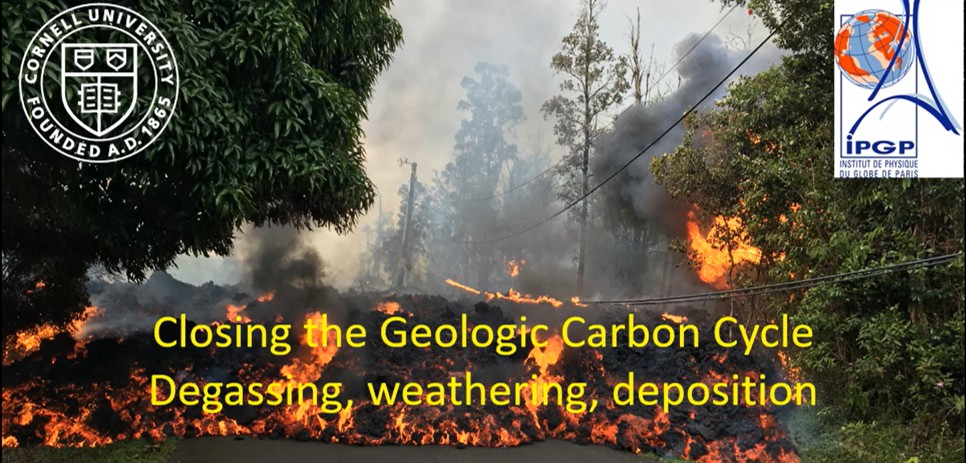
Discrepancies in Global Carbon Cycle: How Prof. Louis A. Derry Cracked Carbon’s Cold Case
The Geochemist and the Mountain
When Prof. Louis A. Derry stepped onto the stage, he brought with him the quiet confidence of a geochemist who has spent over four decades uncovering the hidden patterns of our planet. His work spans from the rugged cliffs of the Alps—where tectonic collisions heat rocks and release carbon dioxide—to the deep valleys of the Himalayas, where rivers carve pathways for Earth’s carbon flow. As Director of the Critical Zone Observatory National Office, Prof. Derry blends field observations with cutting-edge isotope analysis to trace how carbon moves through volcanoes, sediments, and soils. His scientific roots lie not in the lecture hall, but in the mining world—working with Homestake Mining and Chevron—where he developed a practical sense for Earth’s rhythms. Today, his research in places like Hawaii and France shows how mountains do more than stand tall—they store, release, and reshape the carbon that drives Earth’s climate engine. His talk emphasized how these slow-moving geological processes have profound influence on atmospheric carbon levels, hydrological pathways, and even life itself.
🌌 The Ghost Carbon Paradox: When Earth’s Ledger Refused to Close
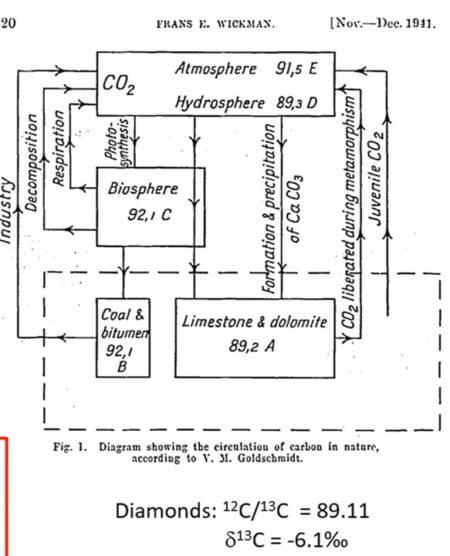
When Prof. Louis A. Derry took the stage, he didn’t just present data—he unraveled a mystery. With a quiet yet piercing tone, he invoked the forgotten voice of Frans Wickman, who in 1941 proposed a startling anomaly in Earth’s carbon budget. Wickman’s isotopic math wasn’t flawed; it was inconvenient. His calculations implied that billions of tons of carbon were unaccounted for, suggesting that the global carbon cycle was not balanced as textbooks claimed. For generations, the geoscience community glossed over this “ghost carbon,” favoring symmetry over scrutiny. But Derry wouldn’t let the silence persist. Drawing from decades of isotope geochemistry across diverse terrains—from river basins to volcanic arcs—he built a case that Earth doesn’t obey tidy accounting. His insights, rooted in fieldwork and isotope tracing, reveal that weathering, erosion, and deep Earth processes introduce massive lags and leaks into the carbon story. As he traced the lingering deficit on his slide, he wasn’t just pointing to numbers—he was spotlighting our intellectual blind spots. “Nature doesn’t do neat,” he said, letting the silence settle. The Ghost Carbon Paradox, to him, is not just a puzzle; it’s a call to reimagine geochemical truths we’ve too long accepted. As he spoke, it felt like carbon atoms danced just out of reach, whispering secrets of a billion years past. Derry’s message lingered: the planet is still hiding stories beneath our equations—and it’s time we listened more closely.
🌊 Rivers of Deception: The Isotopic Imposter Unmasked🎭
🌋 Earth’s Hidden Kitchen: Where Volcanoes Simmer and Mountains Breathe Champagne🥂
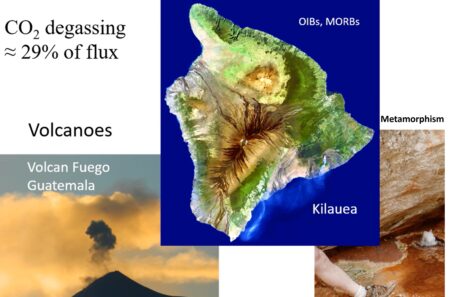
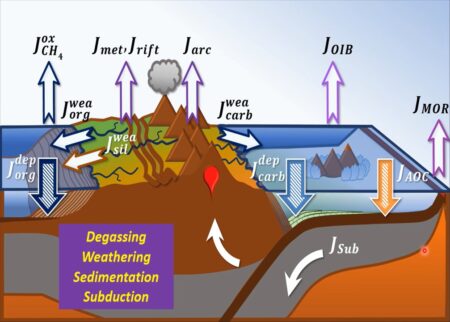
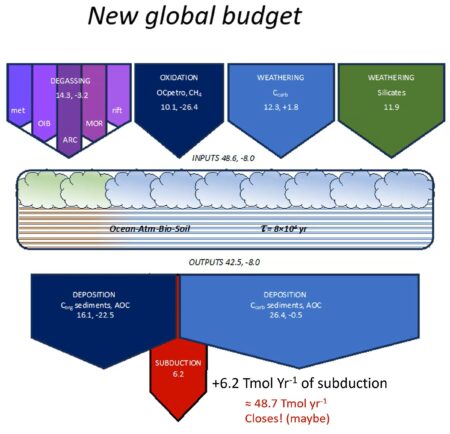
Prof. Derry’s laser pointer lit up the slide. “Volcanoes? Just appetizers; only 29% of Earth’s CO₂,” he quipped. Then came the reveal: Nepal’s Annapurna range, where 55°C metamorphic CO₂ bubbled from alpine streams. “Sleeping mountains exhale,” he said. “Champagne from the deep.” We often focus on degassing, but that’s just a slice of the story. Only ~30% of oceanic carbon comes from it, via volcanoes, mid-ocean ridges, and continental rifts. The bigger chunk (~45%) is recycled from sedimentary rocks in mountain belts like the Alps and Himalayas. Even Earth’s highest peaks breathe carbon. The remaining ~25% comes from silicate weathering, providing partial balance. The isotope math? 20,000 data points now constrain this puzzle: 48.6 Tmol C enters oceans; 48.7 Tmol exits via burial and subduction. For a moment, the room held its breath; a century-old paradox, balanced.
🚧 Subduction’s Great Snarl: When Earth’s Recycling Line Froze⏳
Methane’s Great Heist: Earth’s Invisible Redox Rebellion🔥
Dr. Derry’s lecture traced a striking contradiction: Earth’s carbon system seems in balance, yet its parts clearly aren’t. Burial fluxes of carbonate and organic carbon now match estimates (~26–28 Tmol/yr and ~16 Tmol/yr), allowing better model constraints. New techniques-using δ¹³C and radiocarbon in river particulates- reveal that recycled organic carbon is heavier than expected, likely due to methane loss from kerogen during weathering. Thermogenic methane, produced deep in sedimentary basins, is light (~44‰ δ¹³C) and escapes reaction easily, quietly shifting both isotope budgets and redox states. When this methane oxidizes, it consumes oxygen, while the burial of organic carbon continues to rise. The result: Earth is oxidizing while burying more reduced carbon. Derry’s updated model integrates all this, showing near-closure of fluxes: degassing (~14 Tmol/yr), organic oxidation (~10), weathering (~12 each for silicate and carbonate), and sedimentation, implying a fragile steady state. Yet carbonate burial is double its weathering rate, and much of it won’t return via subduction for over 100 million years. The paradox? The system appears balanced, but isn’t, not over a million-year scale. Dr. Derry’s revised carbon budget suggests Earth’s surface may be in a slow but real transition, driven by hidden fluxes we’re only just beginning to quantify.
The Silent Imbalance: What Earth's Carbon Record Tells Us
Dr. Derry closed with a sobering vision “one side of the slide showed humanity’s surging CO₂ emissions, a near-vertical climb that now eclipses even the Siberian Traps eruptions linked to Earth’s worst mass extinction”. The other side displayed the planet’s built-in stabilizers: weathering of silicates, burial of organic carbon, and slow sedimentary recycling; processes that have long buffered climate shifts. But his message was clear: this feedback isn’t infinite. With carbon burial now exceeding weathering return, Earth’s carbon budget teeters. We may feel stable, but the imbalance is growing, and without care, even the most resilient systems can unravel.
About the Author