
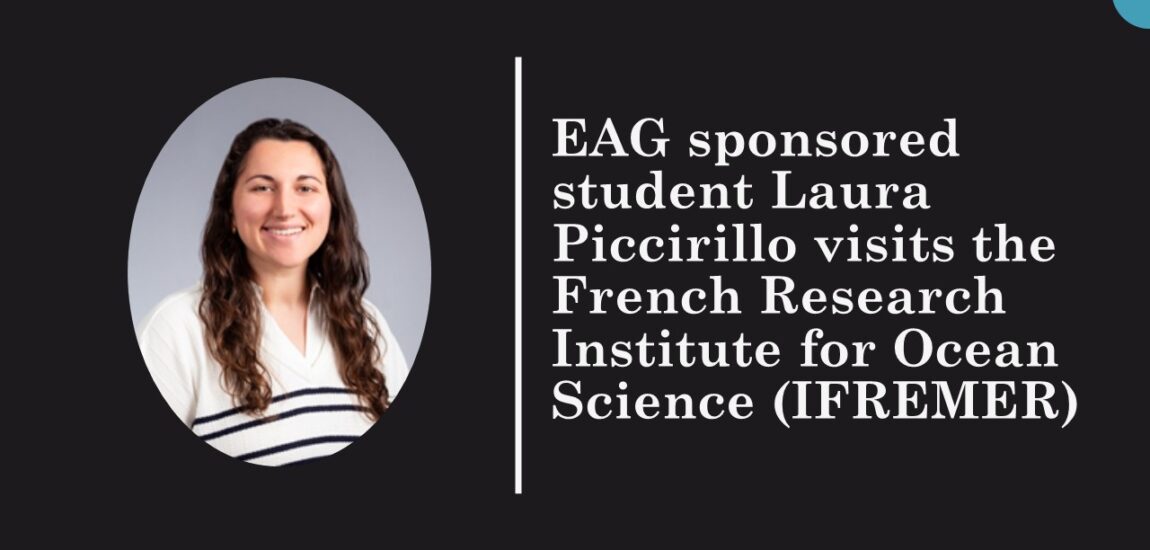
EAG sponsored student Laura Piccirillo visits the French Research Institute for Ocean Science (IFREMER)

I recently visited the French Institute for Ocean Science (IFREMER) in Brest, France for a 1-week short research stay, thanks to the support from the EAG Student Sponsorship Award. The main priority for this visit was to collect samples from Black Sea sediment cores. Acquiring these samples was imperative to the progression of my dissertation work, as the samples will be used to complete a specific project within my dissertation. The Black Sea is a unique, modern, euxinic environment and therefore, it is a valuable setting to further our understanding of redox dynamics. Access to sediment samples from the Black Sea provides us the opportunity to study selenium (Se) redox dynamics in a modern euxinic basin, which is the main priority for this phase of my work. Participating in the collection of these samples also allowed me to better understand the samples and how they have been preserved before proceeding with geochemical analyses.
My experience at IFREMER was extremely positive. Our collaborator at IFREMER (Dr. Antoine Crémière) was a fantastic host, and showed me various instrumentation, lab spaces, and sampling equipment that IFREMER has. Also during my visit, I was able to see the MC-ICP-MS instrumentation at IFREMER (Thermo Fisher Neoma). For my work, I am conducting isotopic measurements with a similar instrument (Nu Sapphire), so being able to see a different MC-ICP-MS lab and how their setup compares to our own was impactful.


During my visit, I also met many other scientists, post-doctoral scholars, and graduate students who are based at IFREMER. Many of these scientists work on similar topics to my own, so having this opportunity to connect with them was important for future collaborations and networking. After the short research stay, I attended the Goldschmidt conference in Prague to present a poster on my Se isotope work and already saw many familiar faces from my stay at IFREMER, which was really rewarding! These connections are important both currently for my dissertation progress and potentially in the future as well. Finally, visiting western France was very fun and I enjoyed my stay in the beautiful seaside city of Brest.
I would encourage any student interested in short research stays based in Europe to apply for the EAG Student Sponsorship. The application process was straightforward and the folks at EAG have been very helpful on the logistical side. These experiences are valuable as graduate students both personally and professionally, and I am grateful to have been given this opportunity thanks to the support of the EAG.
About the Author
