The Value of Collections in Fuelling New Research
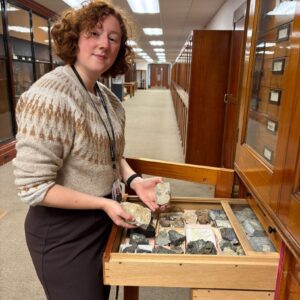
I’m sure everyone reading this has picked up a couple rocks from field work and stored them somewhere, be that an office, garage or dedicated storerooms. After you’ve finished work on those though, what do you do with them? What value do they have? I’d like to share how collections have helped fuel my research, and how it would have never been possible without it.
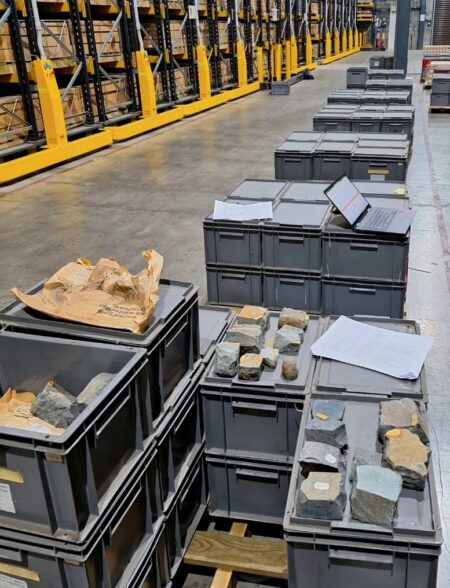
I study the Antarctic Peninsula, specifically looking at subduction-volcanics and linking their geochemistry to the evolving geodynamic setting. The Antarctic is one of the most challenging and harsh environments to work in, and it is legally and logistically very difficult (and expensive) to do any sample collection. Therefore, my work is entirely remote, so I turned to available collections, in particular I make use of the British Antarctic Survey’s collection.
The British Antarctic Survey began operation as a top-secret WWII mission called ‘Operation Tabarin’, following the war it became the Falkland Islands Dependencies Survey, this is where their collection begins. Today, the British Antarctic Survey hold over 100,000 geological samples, the oldest samples in the collection date from 1946.
This collection is very useful to my research for a few reasons, first and foremost being, the strength of record keeping. The methods for labelling a sample set out in the early days of the Falkland Island Dependencies Survey have been used to this day and allow every sample to be identifiable at a glance.
Each geological sample follows the sample numbering method:
- A letter code denoting base (or station), ship, or region the expedition relates to
- The station number, what defines a ‘station’ can be broad, but every station has a unique number and location, which are not to be repeated
- The number of sample out of the total samples collected from that station
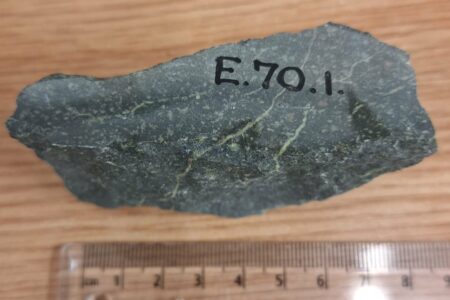
In practice, that can look like this :
E.70.1
E – This relates to Base E, which was located on Stonington Island and was in operation sporadically between 1946 and 1975
70 – station no. 70, this is labelled and located on maps and sheets
1 – this is the first sample they collected from station 70
Almost every single sample uses this system, at a glance you can tell where a sample came from and when. These records have been written and transcribed into databases so that the details of who collected a sample, what it is, from where, when, and any notes can be found in a second. These can be plotted and geolocated. This rigorousness allows for research to be done that otherwise would have never been achieved. Without these clear records, sample E.70.1 would just be a volcanic rock, however, with these records it becomes a sample that can be used in research.
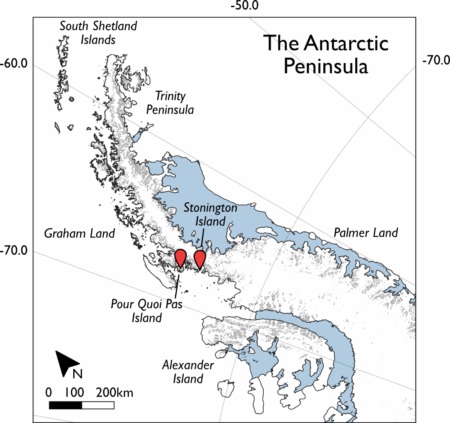
Sample E.70.1 is from Porquoi Pas Island (see map above) and was collected in 1948 by Sir Vivian Fuchs. I have used it for geochemical analysis, gathering whole rock major and trace element data using XRF and ICP-MS analysis. With which I am furthering our understanding of the development and demise of the subduction zone which formed the Antarctic Peninsula. Reflecting on the advancements since that sample was collected truly highlights how something that may seem of little value, can in time become critical. Sample E.70.1, 76 years after collection has enabled the collection of new data using techniques that couldn’t have been imagined, to learn about a setting and processes which were all but unheard of the time.
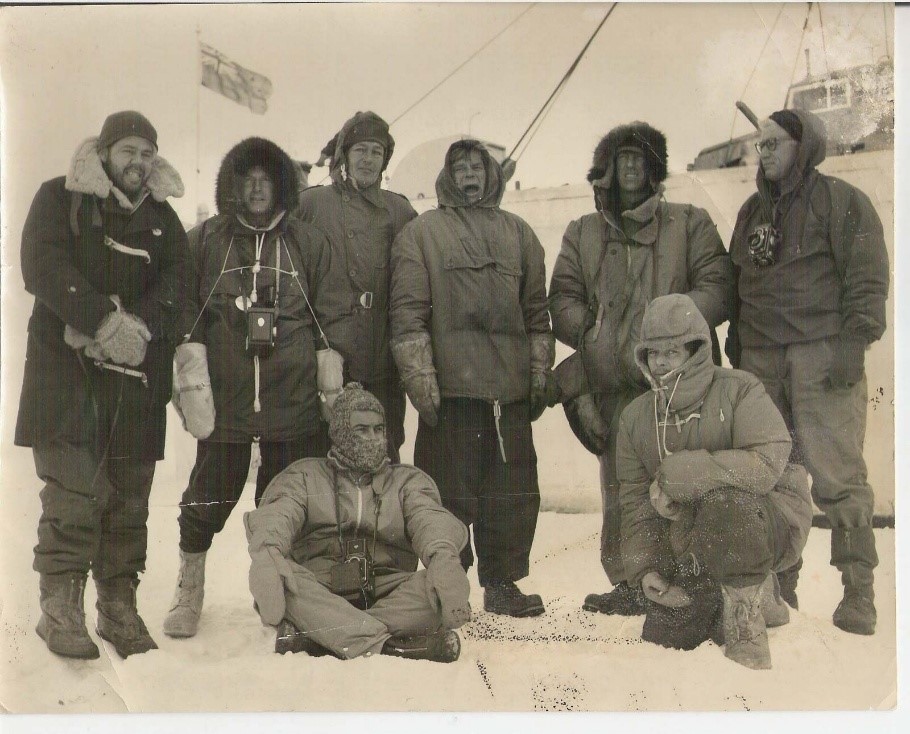
For decades geologists braved one of the harshest conditions on Earth to survey, learn, document, and collect. Many of whom never got to see what became and what will become of that work.
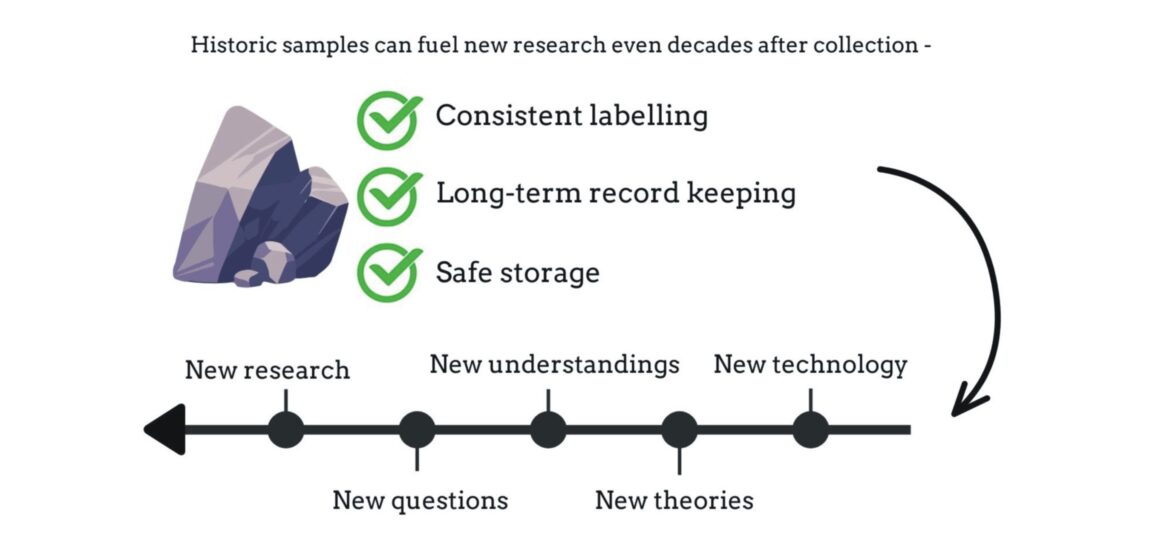
Historical collections are a crucial source of material for locations that are difficult to or can no longer be reached. A single sample, well-kept and well documented, may well support research decades after the initial work has concluded. In fields that don’t yet exist, to support theories that haven’t yet been thought, and through techniques that haven’t been developed. Even if it seems that that sample gathering dust in your office may have no value, it may simply be that the value hasn’t yet been discovered.
About the Author