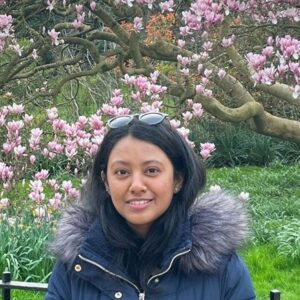
EAG Sponsored Student Moni Boruah presents her Lunar Volatile Research at the 11th European Lunar Symposium
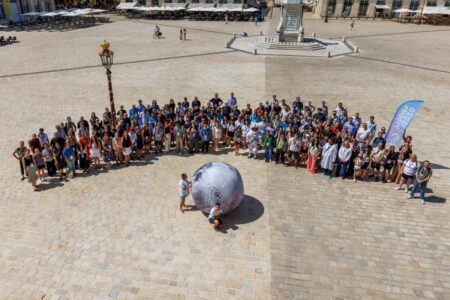
This year, with the generous support of the EAG Student Sponsorship Programme, I was able to attend the 11th European Lunar Symposium organised at the Aquarium Museum of Nancy, France, from June 21–26, 2026. I am a 3rd year PhD student at The Open University. My research focuses on lunar magmatic volatiles, such as Chlorine and Hydrogen, to better understand their origin and distribution in the lunar interior. The European Lunar Symposium (ELS) is an annual lunar science and exploration conference organised in collaboration with the NASA Solar System Exploration Research Virtual Institute (SSERVI) and its European nodes. It was first started in 2013 as a platform to bring the European lunar community under one roof. Now in its second decade, it convenes stakeholders from academia and industry and is slowly uniting space organisations worldwide to advance lunar exploration and science.
Celebrating the summer solstice, the conference opened with an icebreaker and a rock concert, creating a relaxed, fun, hot summer evening to greet old colleagues and meet new participants. Throughout the week, I attended presentations about updates on lunar exploration programmes from across the globe; science derived from spectral observations of the Moon; in situ resource utilisation for long-term presence on the Moon; and insights from sample analysis and curation. As an isotope geochemist, I was amazed by how different approaches and perspectives can be employed to understand similar scientific questions. It also revealed the ways in which my own work could indirectly shape framing the science objectives for future lunar missions.
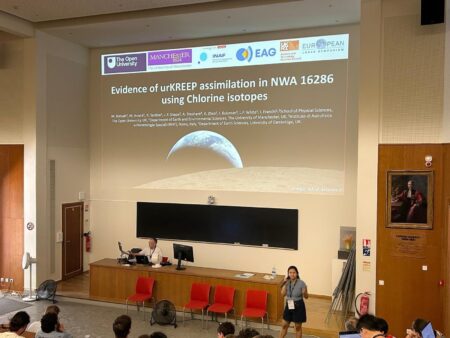
I presented my work – Chlorine isotopes from lunar meteorite, Northwest Africa (NWA) 16286. Here, using the Nanoscale secondary ion mass spectrometry (NanoSIMS 50L), I explored the temporal evolution of chlorine isotopes from an early-formed melt captured by olivine-hosted melt inclusions (OHMI) to late-stage apatite and presented two evolutionary scenarios: (a) magmatic degassing of Cl-bearing species after OHMI entrapment, followed by extensive crystallisation before apatite formation and (b) assimilation of a Cl-rich urKREEP component soon after the entrapment of OHMI to explain the observed isotopic offset in Cl-δ37Cl systematics of NWA 16286.
My talk was on the last session of the conference. Reflecting on it now, it was a nerve-wracking but also oddly satisfying experience. Days after the conference, I continued to receive emails from a few colleagues, which allowed me to appreciate the opportunity to present my work to a wider community and build my professional network. In addition to my presentation, I had the opportunity to serve on the scientific organising committee and co-chair the sample analysis and curation session. This was very beneficial to gain insights into organising and delivering an international conference as I move forward in my career.
Key highlights of the conference included the ESA-led Town Hall, where we discussed opportunities to work with ESA and the past, present, and future of lunar space exploration. I also attended a plenary talk by Dr Sebastian Besse on updates and excitement about the Bepicolombo approach to Mercury (the Moon’s look-alike). A particularly emotional moment of the conference was the tribute to Dr Riccardo Pozzobon, remembering him as a fun-loving human and honouring his contribution to the scientific community. This made me respect the welcoming nature and the sense of connection within the whole community.
During the coffee breaks, I greatly enjoyed conversations about lunar volatiles, living on the Moon, and upcoming missions, which also led me to a collaborative project with INAF in Italy. For my PhD project, I also work on mare basalts from the Apollo Next Generation Sample Analysis (ANGSA) Programme. During these breaks, I was able to interact with the programme’s team members, which was very helpful for planning future work and learning more about sample acquisitions. Together, these made attending ELS-2026 in the final phase of my PhD very fruitful and encouraging.
Besides the conference, I enjoyed the tour of Nancy and the royal gala dinner, which was held in the Grand Salons (Stanislas Palace). We were in Nancy during a severe heatwave that affected the whole of Europe, with temperatures soaring up to 42°C. I am very grateful to the local organising committee for their hospitality in ensuring everyone stayed hydrated and safe.
Having attended ELS since the first year of my PhD, I would advise anyone working in lunar science to attend this symposium, as it brings researchers, industry, engineers, and space organisations all under one roof. I am very grateful to EAG for supporting my attendance and would highly recommend the sponsorship to early-career researchers working in geochemistry.
Thank you.
About the Author