

My experiences as an EAG Early Career Ambassador at the 15th Field Workshop on Volcanic Gases, Hokkaido (Japan) 2025

From August 31 to September 7, 2025, I had the privilege of taking part in the 15th Field Workshop on Volcanic Gases held in Hokkaido, Japan. I am deeply grateful to the European Association of Geochemistry (EAG), which awarded me the Early Career Science Ambassador grant and provided the financial support that made my participation possible. The meeting was excellently hosted by our Japanese colleagues with the support of the IAVCEI Commission on the Chemistry of Volcanic Gases (CCVG). This workshop had been long anticipated, originally scheduled for 2020 but postponed due to the pandemic.
The experience was meaningful on many levels. Scientifically, it provided an updated overview of recent advances in volcanic gas research, with stimulating discussions and the opportunity to see innovative techniques applied in the field. Personally, it was also my first time in Asia—and in Japan—which made the experience culturally and emotionally enriching. Encountering Japanese hospitality, history, and cuisine, while connecting with colleagues from across the globe, made this week unforgettable.
My first CCVG field workshop took place in Ecuador in 2017, when I was a PhD student just starting to enter the international volcanic gas community. Eight years later, attending Hokkaido 2025 felt very different. My passion for volcanic gas geochemistry has deepened, along with my sense of responsibility within the community. This year, I had the honour of serving on the scientific committee, collaborating with colleagues to review abstracts and shape parts of the program. I also chaired the session Deciphering Volcanic Processes Using Gas Emission Observations, which allowed me to engage directly with excellent presentations and discussions. In this spirit, I also put myself forward as a candidate for co-leader of CCVG, with the hope of continuing to contribute ideas, energy, and enthusiasm to this community.


I presented a poster entitled Redox state of hydrothermal systems and implications for volcano monitoring: new insights from hydrocarbon geochemistry in Mediterranean fumarolic emissions. Together with my co-authors, we introduced a set of chemical and isotopic parameters based on light hydrocarbons, such as methane, to trace magmatic SO₂ input in hydrothermal systems. Because SO₂ is a key indicator of shallow magmatic degassing, demonstrating its release at depth before it reaches the surface can provide essential insights for volcanic monitoring and eruption forecasting. Sharing these results and receiving feedback from colleagues was particularly rewarding and opened new perspectives for future applications.
The field component of the workshop was another highlight. We visited Kuttara, Tarumae, and Usu volcanoes, where research teams carried out gas sampling and measurements, compared methods, and tested new approaches. Working together in the field fostered collaboration, exchange, and friendship, while reinforcing the hands-on, cooperative spirit that makes these workshops unique.
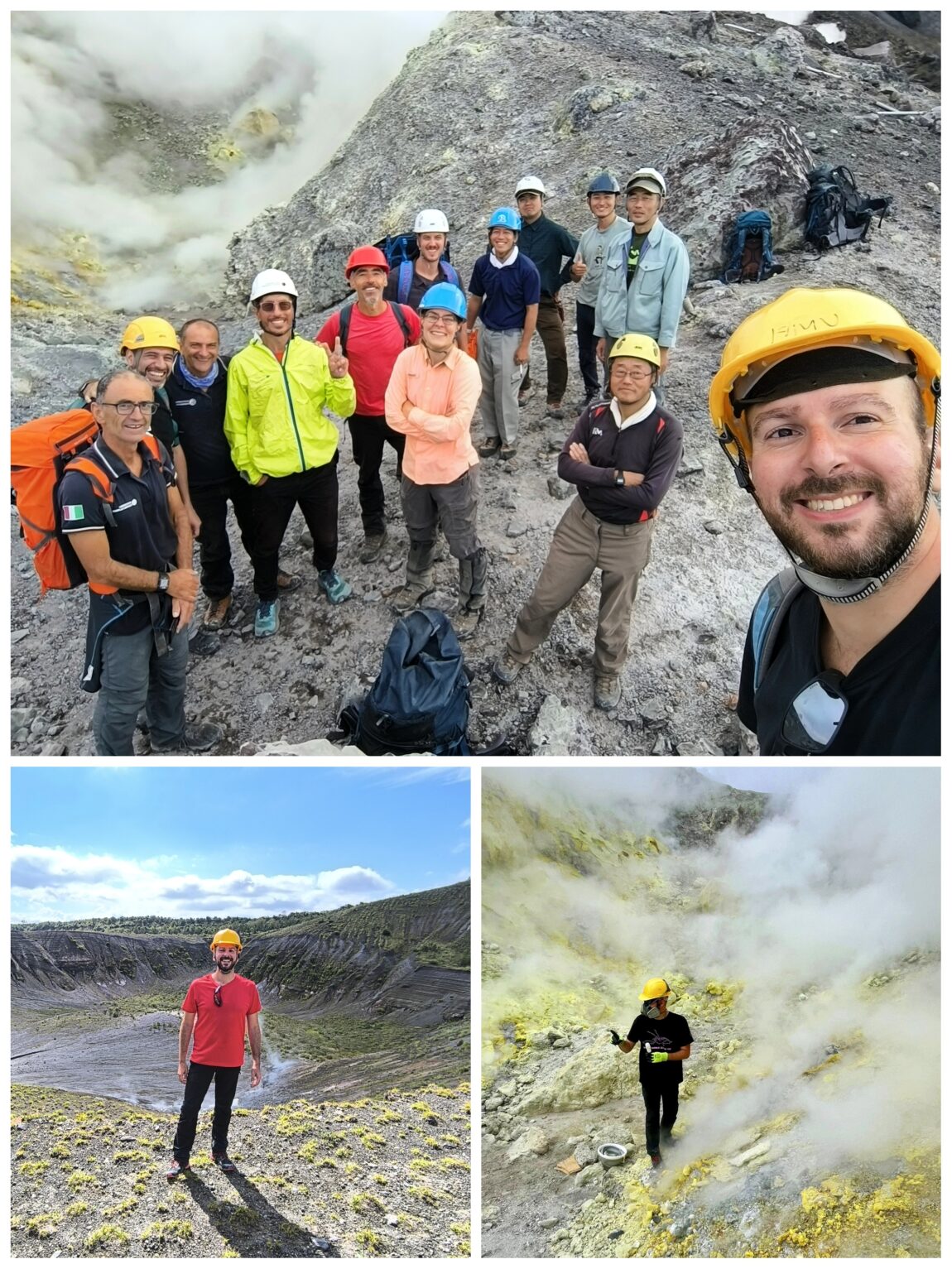
Beyond the scientific dimension, I take home many warm memories: evenings in Sapporo, peaceful moments by Lake Tōya, laughter during fieldwork, and the unforgettable flavours of Hokkaido’s cuisine. This experience strengthened my commitment both to research and to the CCVG community, while leaving me with a deep sense of gratitude for the opportunity.
I sincerely thank the European Association of Geochemistry (EAG) for its support in making my participation possible. Finally, I warmly encourage colleagues from the volcanological and geochemical communities to join CCVG: it is a stimulating network where science, collaboration, and friendship come together to advance our understanding of volcanic processes.
About the Author
