

EAG Sponsored Student Anulekha Prasad’s research visit to Europe
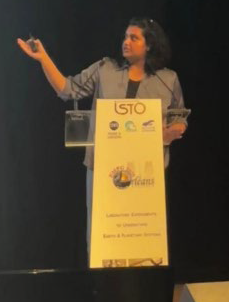
This summer, I had the opportunity to attend the International Symposium on Experimental Mineralogy, Petrology and Geochemistry (EMPG 2025) conference in Orleans, France, and to take part in an exciting synchrotron experiment at the European Synchrotron Radiation Facility (ESRF) in Grenoble, France. My extended European research visit was in supported by the EAG sponsored student program.
As a PhD student at NTU, Singapore, focusing on high-pressure mineral-fluid interactions, being part of EMPG was a meaningful experience for my research. It was a rare opportunity to connect with others who use similar experimental approaches, including researchers from ISTO in Orléans and working groups from the University of Münster and the University of Potsdam, among many others. Being surrounded by people who immediately understood the challenges and small victories of this type of work felt very encouraging.
This conference was also the first time I had ever given a scientific talk. My presentation focused on how water’s molecular structure changes under high pressure, and how this affects the dissolution of anhydrite. I had practiced my talk many times before the session, but once I was on stage, brand-new pronunciations emerged, and my sentences occasionally wandered off without me. In the moment, it felt like I was starring in a live demonstration of “How Not to Present a Talk,” destined for archival playback in future classrooms. However, the response afterwards was unexpectedly warm. People approached me to discuss the result that anhydrite dissolves more readily once water shifts toward its high-density structural state, and how this might affect sulphate transport at depth. Others asked about the Raman setup and calibration. It reminded me that even when the delivery feels imperfect, the ideas can still come through.
Throughout the conference, I had many discussions about the challenges of high-pressure spectroscopy, data interpretation, and the need for a strong statistical grounding when presenting experimental trends. I met several researchers working with related systems and techniques, and some of these discussions have already developed into a potential collaboration that I am currently exploring further. I also made new friends, which made the experience even better.

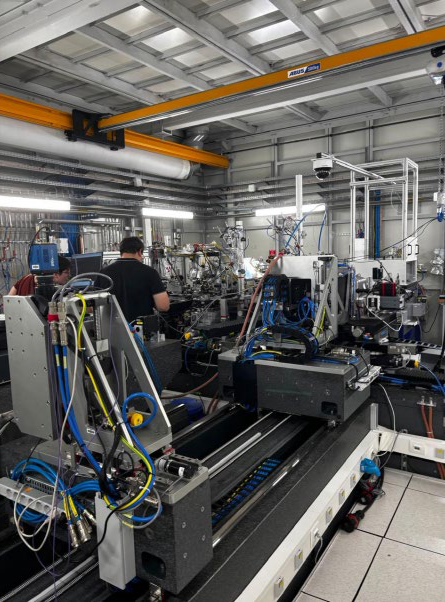
After EMPG, I travelled to Grenoble to participate in a synchrotron experiment using a membrane-type diamond anvil cell, using in situ X-ray absorption and fluorescence methods. The proposal focused on examining how sulphate and chloride complexes of rare earth elements behave in high-pressure aqueous fluids. The experience at ESRF (European Synchrotron Radiation Facility) was remarkable. I saw how much patience and persistence are required to collect data under extreme conditions. Dr Marion Louvel and Dr Alex Gysi, who led the proposal, worked almost continuously, carefully adjusting the setup and discussing strategy throughout the nights. The beamline scientists were incredibly dedicated, often staying long past their scheduled hours to assist. Their steady focus, even deep into the night, showed me how much of science relies on patience as much as technique. Watching the experiment progress in real time gave me a deeper appreciation of the effort that goes into each dataset that eventually appears as a single point in a figure.
These two experiences had a strong impact on my development as a researcher. I gained confidence in presenting my work, learned how to refine my measurements to ensure reliability, and saw how complementary experimental techniques can work together. I also felt closer to the larger geochemistry community, which can sometimes feel distant when working alone in the lab.
About the Author
