
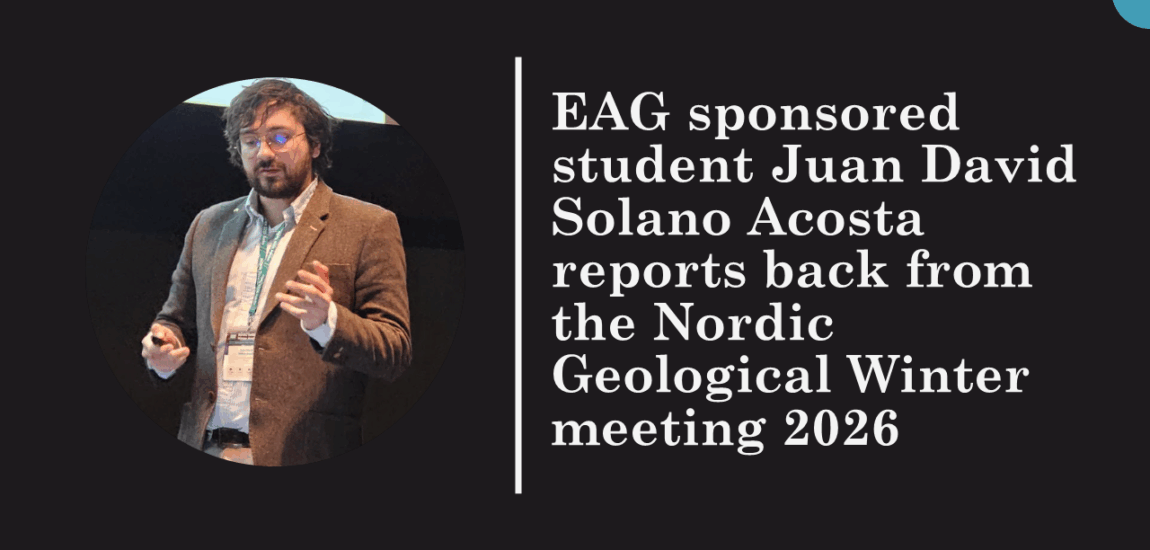
EAG sponsored student Juan David Solano Acosta reports back from the Nordic Geological Winter meeting 2026

Participating in the NGWM26 conference was an important and timely step in my academic journey, taking place at a key moment just before my doctoral defense. As a researcher working on the geophysical and geochemical characterisation of Estonia’s concealed Precambrian basement, I found attending an international meeting focused on geodynamics, mineral systems, and crustal processes essential for placing my work within a broader scientific context. The EAG Student Sponsorship enabled me to present my research and participate in the associated workshop, both of which had a clear professional and personal impact.
From a professional perspective, the conference was highly rewarding. I delivered an oral presentation entitled “Alutaguse and Jõhvi Zones, North Estonia: Geochemical and geophysical evidence for Paleoproterozoic back-arc evolution and critical raw material potential,” in which I integrated historical drill-core geochemistry with modern gravity and magnetic modelling to refine the tectonic and metallogenic framework of the Estonian basement beneath thick Phanerozoic cover. The presentation formed part of Session 7, “Fennoscandian Shield beneath Phanerozoic cover — correlations, tectonic setting, and metallogeny,” where experts from the Estonian and Finnish Geological Surveys, together with colleagues from Estonia and the wider Baltic region, provided insightful and constructive comments.

Presenting this work to a specialised audience enabled in-depth discussions with researchers working on comparable Svecofennian and Bergslagen-type systems. The constructive feedback received during and after the session helped refine how I communicate my results and highlighted new directions for future comparative studies. In addition to the oral contribution, I also served as a co-author on a poster on Estonian rapakivi bodies, further broadening scientific exchange.
A particular highlight of the conference was the Metamorphic Petrochronology workshop, where I gained practical exposure to metamorphic and diffusional modelling, geochronology, and XMapTools. This training deepened my understanding of the geological significance of age determinations and improved my ability to interpret metamorphic processes and the broader evolution of geological samples. The workshop was especially valuable, as it directly enriched both my current research and my methodological perspective.
On a personal note, the experience was both intense and rewarding. Balancing the preparation of my presentation in the days leading up to my PhD dissertation defence was demanding, but engaging with the vibrant scientific community throughout the conference was highly motivating and helped me refine my ideas for a stronger dissertation. The venue promoted open discussion, and the social activities offered a casual environment for networking and informal conversations.
For other students planning to attend similar events, my advice is to prepare well in advance, actively participate in discussions, and take full advantage of both formal sessions and informal networking opportunities. Conferences are not only a platform for presenting results but also an important space to build confidence, gain perspective, and establish connections that can shape future career paths.
About the Author
