
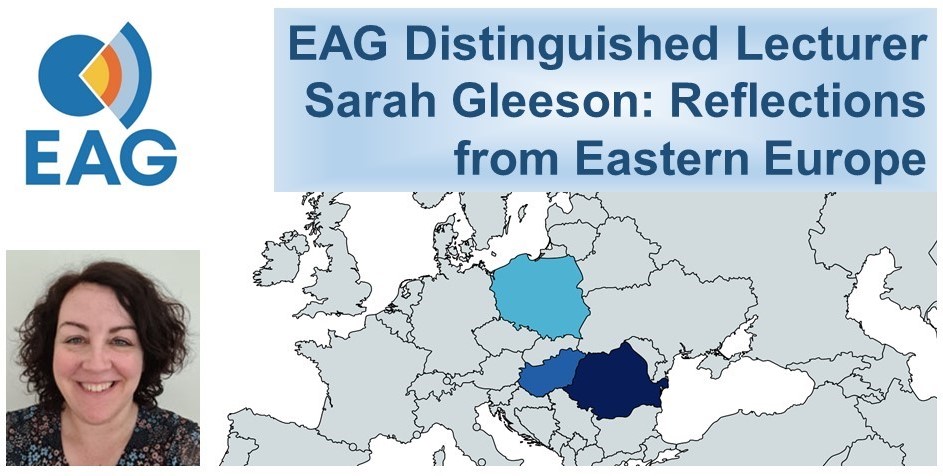
EAG Distinguished Lecturer Sarah Gleeson: Reflections from Eastern Europe

I finished my undergraduate degree at Trinity College, Dublin in 1992. At that time in Ireland the unemployment rate was 16%, and there was very little money in the Irish system to support research. So, it was clear we would have to emigrate if we wanted to continue our studies or get a job in the geosciences – certainly a permanent academic position was an impossible dream. In the decades since then, many remain scattered around the globe. I have just returned to live in Ireland after more than 3 decades and it is a very different country to the one I left. It is certain that the European Union had a major impact on the research landscape and the infrastructure required to build our current economy.
I was privileged to be awarded the EAG Distinguished Lecturer award in 2024/2025 and I travelled to give lectures in Hungary, Poland and Romania. In Hungary I travelled to Veszprém for 20th Winter School in Mineral Sciences and gave two talks. Thanks are due to Mihály Pósfai and Csaba Szabó and their teams for their hospitality and efficient shepherding to, and from, the venue. I then travelled to Krakow to visit the Institute of Geological Sciences at Jagiellonian University where my host was Kinga Jarosz. Finally, in Romania, I was hosted by Gabriela Iorga and Mihai Ducea of the University of Bucharest and gave a talk on copper deposits to members of the graduate school.
Overall, I was struck by similar themes in all three countries. All three countries have had some investment from the EU, and early career researchers that have access to EU grants and programs like the ITN have many more opportunities for training and travel than previously. On top of this, there has been some investment in new scientific infrastructures. I visited the TEM facility in Veszprem, the microscopy suite in Jagiellonian University, and the University of Bucharest are building a major new radiogenic isotope facility. Of course, more investments are always needed!

The publication of the Critical Raw Materials Act by the EU in 2023 also opens the door for new opportunities for Eastern Europe. For example, many of the geological surveys in the EU are developing National Exploration Programs. This means there are renewed opportunities in mapping, geochronology and the collection of new geochemical and geophysical datasets. There is also an uptick in mineral exploration activities in Eastern Europe, with a mixture of traditional mineral exploration projects as well as interest in activities such as “re-mining” waste materials from old mining operations. Such activities should be carried out in collaboration with the local universities and offer training opportunities for undergraduates and post-graduate students.

Finally, in all three countries I met talented and passionate early career researchers who dream of permanent positions in their home countries, but like me at the same stage, must decide whether to leave academia or to travel internationally to find post-doc opportunities. Although this prospect is daunting, this is also an opportunity to build new skills and develop an extended global network which will benefit all in the long term. It is clear there is a large pool of talented researchers looking for opportunities and I hope that eventually, many of them will end up living and working in their home countries…perhaps without having to wait 30 years!
About the Author
