When the Southern Ocean Breathes🌊: Prof. Elisabeth Sikes Unlocks Antarctica’s Carbon Code 🔓 for Climate Control ♻️
Why This Study Matters ? 🌍

For centuries, we treated the Southern Ocean, a vast, turbulent body of water encircling Antarctica, as a passive carbon sponge. Absorbing up to 40% of anthropogenic CO₂, it has been a lever in glacial-interglacial shifts. Prof. Elisabeth Sikes’ 2025 Goldschmidt plenary talk peeled off the layers of this mystery, revealing how the ocean “exhales” CO₂ during warming periods—a process critical to understanding both past and future climate change. At Goldschmidt 2025, Prof. Sikes explained this critical role with stirring clarity, “When Antarctica exhales, the planet warms. And right now, it’s hyperventilating.” For about 800,000 years, it functioned like a climate-regulating “trapdoor,” locking away CO₂ through ice ages and releasing it during warming periods. Her talk showed that today’s record-low sea ice threatens to jam that carbon valve open, with potentially accelerating global warming.
The Scientist Behind the Study: A Lifelong Attachment
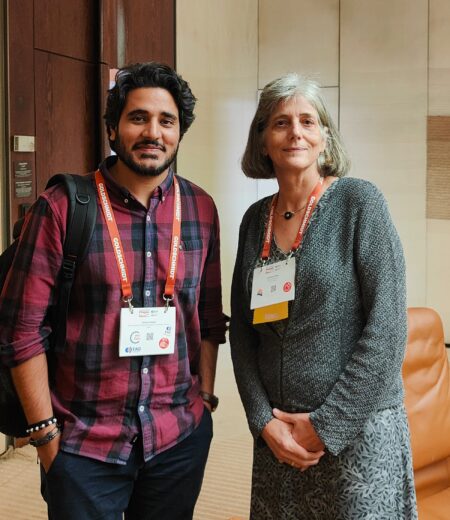
“I didn’t study the Southern Ocean, I survived it.”- Prof. Elisabeth Sikes, who spent three decades braving Antarctic blizzards to harvest sediment cores from the Southern Ocean, each one a “time capsule” revealing Earth’s carbon past. From early expeditions through the Drake Passage to Antarctica, her fieldwork has been as daring as her science. Her 16 ocean expeditions and countless hours in the lab have decoded how shifts in ice, wind, and ocean currents control the planet’s carbon “trapdoor.” She mastered the use of isotopic tracers (like δ¹³C) to decode ancient ocean chemistry, but her real genius lies in connecting these data to physical processes. These sediment cores carry chemical clues, like δ¹³C isotopic shifts, that signal when CO₂ was stored deep below or released to the atmosphere. Using δ¹³C isotopic tracers and geochemical sleuthing, she uncovered that glacial periods locked away up to 20% more CO₂ than today. Her talk reflected this duality as equal parts hardcore geochemistry, “how carbonate species partition at pH 8.1,” and big-picture storytelling, “where the ocean breathes”. As Sikes puts it, “Each core is crime‑scene tape from past extinctions, and a warning we can’t ignore.”
Key Points of the Plenary Talk: The Southern Ocean’s Carbon “Trapdoor” in Action🔍
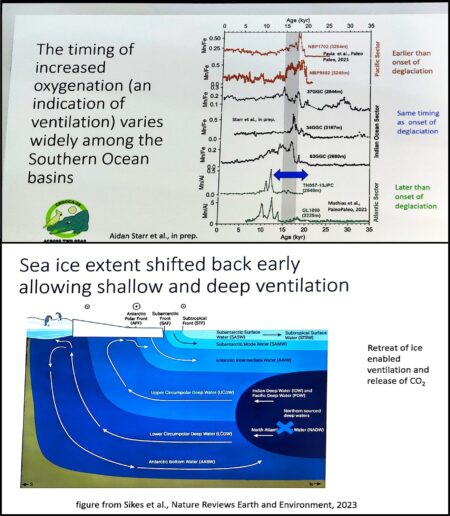
You know that feeling when you hold your breath, then finally let it out and everything changes? That’s exactly what the Southern Ocean does with carbon. Prof. Sikes, in her plenary talk, showed us that during ice ages, thick sea ice and roaring winds locked away massive amounts of CO₂ deep below. Then, as Antarctica warmed and the ice melted, hidden “ventilation hotspots” like the Kerguelen Plateau in the Southern Indian Ocean popped open, and all that gas rushed back out, long before the Atlantic currents even stirred. She even pointed out how sudden spikes in opal flux (those tiny diatom shells) mark the exact moments when nutrient‑rich waters surged upward, fueling blooms that helped bury carbon in the deep, and radiocarbon “age” measurements proved some deep water pockets stayed sealed off for millennia before finally mixing and unleashing their carbon. Today, with sea ice at record lows and winds shifting back toward those old patterns, we’re eerily repeating that same script—and unless we start dropping sensors through the Drake Passage to catch these exhale events in real time, we might not get a single warning before the next big breath changes our climate again.
The Urgent Call for Real‑Time Monitoring 🚨
Today’s Southern Ocean eerily mirrors the conditions that triggered past climate upheavals: Antarctic sea ice is at record lows, westerly winds are intensifying, and bathymetric “ventilation hotspots” like the Kerguelen Plateau are poised to unleash stored CO₂, potentially flipping this region from carbon sink to source by mid‑century. Prof. Sikes warned that our climate models still omit these powerful feedbacks, risking unanticipated warming of up to 0.6 °C from the ocean “exhales” alone. Her urgent prescription is equally clear,“We must deploy 500 autonomous sensor floats through the Drake Passage by 2026 to track the Southern Ocean’s carbon exhales by monitoring real‑time changes in ventilation, alkalinity, and dissolved inorganic carbon and lock these feedback into our climate models.”– “Prof. Elisabeth Sikes. Only by capturing these signals as they happen can we incorporate Southern Ocean dynamics into predictive models and avert a surprise carbon surge. Thank you for plunging into these deep‑sea insights—let’s keep our science buoyant and our climate safe.
About the Author