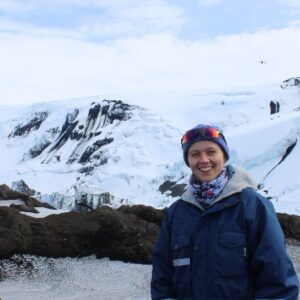
EAG Sponsored Student Laura Wainman Visits the Land of Fire and Ice

Last year an EAG Student Sponsorship supported me in completing an internship at the Icelandic Meteorological Office (IMO) as part of my PhD studies. The focus of my PhD was investigating the airborne emissions of gas and particulate matter during the Fagradalsfjall 2021-2023 eruptions on the Reykjanes Peninsula in Iceland. I was especially interested in the behaviour of trace elements in the volcanic plume, such as Pb, As, Cd, and Se. These trace elements can act as essential bio-nutrients, but can also be environmentally reactive and have implications for air quality and human health. Studying the emission behaviour of these metals can also provide valuable insights into underlying magmatic processes.
My PhD research had taken me to Iceland several times before, but only for a few days-weeks at a time, normally in the middle of an active volcanic eruption. Returning for a more prolonged internship of 2.5 months allowed me the time and space to explore my work, surrounded by highly knowledgeable Icelandic volcanologists, geologists, and technical staff, but without the pressure of a field campaign and trying to collect samples. This additional time was perfect for throwing myself in to learning new sampling approaches and for re-evaluating the datasets I had collected. For example, after helping another student to conduct CO2 soil diffusion sampling around the eruption site, it occurred to me that I could investigate the environmental dispersion of trace elements emitted by lava flows by looking at their uptake in moss. I was then able to collect a variety of moss samples, with help from colleagues at IMO, which I have continued to work on following the completion of my PhD.

One of the best parts of my internship was being involved in the day-to-day activities of a volcano observatory during a period of heightened unrest. As a young volcanologist this is the type of experience you can only dream of! I was able to attend some meetings alongside many scientists from IMO and the University of Iceland as well as civil defence officials and listened to how the different hazards were evaluated and communicated to the public. This insight undoubtedly shaped my research ideas and interest in science communication activities going forward.
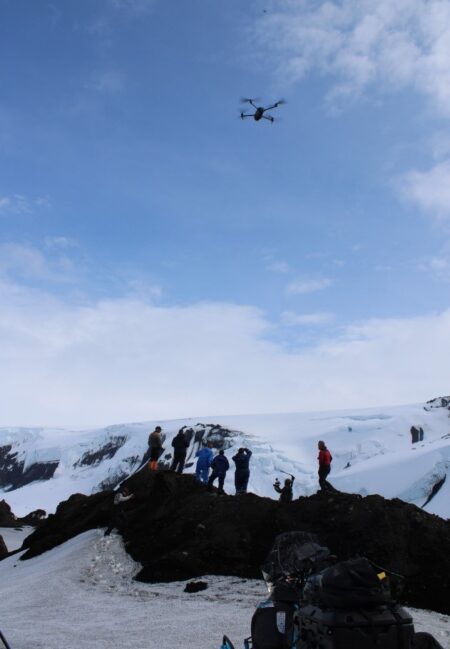
I was also able to be involved in some of the more “active” parts of volcano monitoring during my internship. Iceland has over 30 active volcanic systems, requiring consistent long-term monitoring to better forecast changes in activity or a potential eruption. I was lucky enough to join a trip to the Vatnajökull glacier to collect gas samples and geophysical data at the Grímsvötn, Kverkfjöll, and Bárðarbunga volcanoes which lie underneath the glacier. We stayed on the glacier for just over a week, travelling on snow scooters to collect samples and conduct repairs to the permanent network of monitoring stations. We were even stuck inside our cabin for several days as an orange weather warning storm hit Iceland! It was very cosy, if also quite cramped with the whole team inside a small cabin!

On a personal level it was also an incredible opportunity to live for a more extended duration in another country. I met some lovely friends, enjoyed running around the coastal paths and soaking in the geothermally heated pools (an after work treat that I now miss back in the UK). I was even able to participate in several community events, complete a few tours to learn more about Icelandic history, and even tried outdoor rock-climbing on a massive ancient magma batholith! Overall, my internship was a fantastic experience and I am very grateful to EAG for their support.
About the Author