
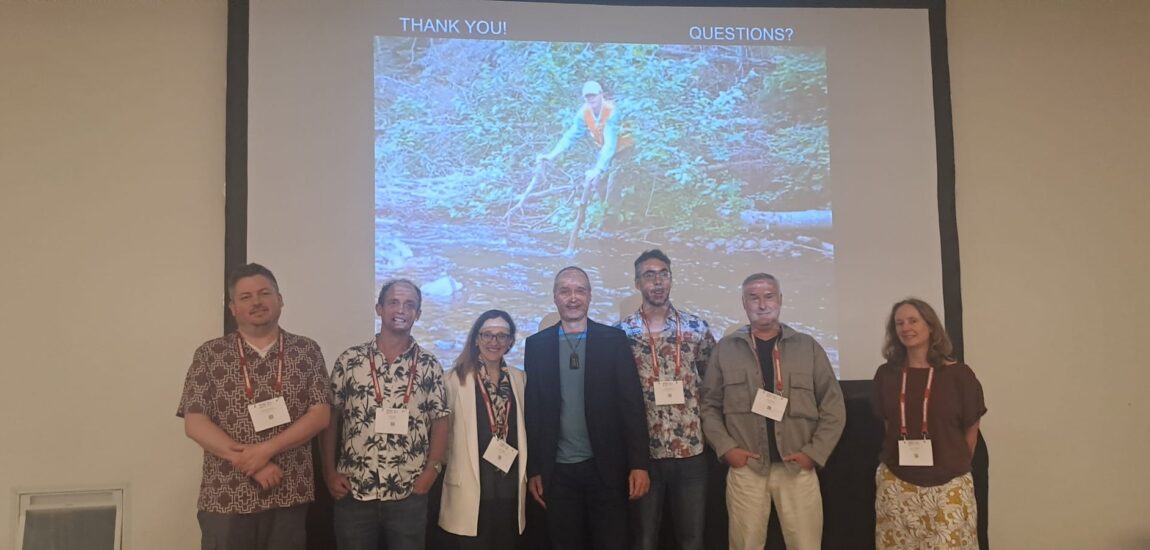
How do you connect diverse research fields in geochemistry? An interview with Balz Kamber
At every Goldschmidt conference, dedicated scientific sessions honour the contributions of geochemists who made significant contributions to the field. This year, one of the celebrated scientists is Prof. Balz Kamber, whose work regularly criss-crosses geochemical ‘silos’ with ‘paradigm shifting contributions’ as his 2025 Geochemistry Fellow description puts it.
In fact, trying to summarise Prof. Balz Kamber’s body of work into a single paragraph is a futile task, given how his research traverses the length and breadth of geochemistry from low-temperature to high temperature, Archaean to Holocene… As I write this blog post, I have multiple journal article tabs open on Archean crustal growth, volcanic crystals archives, continental crust composition from alluvial Australian sediments, to ocean redox proxies from stromatolites. Quite the range of research! Although these topics appear to be disparate, Prof. Kamber has demonstrated that with careful investigation and the right question, these topics are in fact inter-connected.
The session entitled “14a – Connecting diverse research fields through geochemistry (session in honour of Balz Kamber)” celebrates Prof. Kamber’s legacy. Here he talks about his research approach, recalls his most memorable moment connecting diverse research, and discusses the future of interdisciplinary geochemical research.
- You have such diverse research interests in Earth Science and geochemistry, and your research is known for its novel insights and connections. How have you been able to find these connections and insights? Is there a method to ‘the madness’?
Balz Kamber (BK): I observe lines of reasoning that, over time, require more and more exceptions to the ‘rule’. This tends to suggest that an underlying assumption might need revision and/or that a connection has not yet been made. Then I go away and read up to understand how the current paradigm was shaped and whether previous ideas had been dismissed.
- Do you have a story or an experience that has been particularly memorable where you were able to connect two unrelated ‘geochemical silos’?
BK: In the late nineties, there was a debate about why Nb/Th and Nb/U ratios in basalts were giving different answers. As a (then) Pb-isotope geochemist, I was not familiar with the use of the Nb-based ratios but once I heard about the debate, I immediately knew that the Th/U ratio, via 208Pb/206Pb, could solve the riddle. It was a matter of looking for the correct question, rather than deciding between the ‘right’ or ‘wrong’ answer.
- In your perspective, where do you see the future of multidisciplinary geochemical research going?
BK: In my experience, this works best in a team assembled using the ‘T-shape’ approach. Domain experts are selected based on their vertical depth of knowledge, and the overall research is guided by one or two open-minded individuals with a very broad understanding of the overall question ( I + ‾ = T).
- Do you have any advice for early career scientists in geochemistry?
BK: Read the classic literature pertaining to all aspects of your research projects. Don’t be preoccupied by the latest research alone and dare branching outside geochemistry to broaden your skills in petrology, microscopy, computational modelling, etc. Geochemistry has become very competitive. Having additional skills helps to become more creative.
Honoree Biography
Prof. Balz Kamber is a Swiss geochemist based at the Queensland University of Technology, Brisbane, Australia. After earning a PhD in Isotope Geochemistry at the University of Bern in Switzerland, he took up postdoctoral fellowships at the Universities of Cambridge, Oxford, and Queensland before becoming a Tier 1 Canada Research Chair at Laurentian University. Prof. Kamber occupied the Chair of Geology and Mineralogy at Trinity College Dublin. Following his stint in Ireland, Prof Kamber then returned to Australia to his present position. He is one of the 2025 Geochemistry Fellow, a Member of the Royal Irish Academy Member, and a past Niggli Medal winner from the Swiss Geological Society.