

Geochemists on the Move – interview with Réka-Hajnalka Fülöp
Hello! I’m Réka-Hajnalka Fülöp, a Transylvanian-born Hungarian Earth Scientist currently based at the Australian Nuclear Science and Technology Organization (ANSTO), just south of Sydney, Australia. My specialty is cosmogenic nuclide geochronology, which basically means I spend a lot of time convincing rocks to tell me their secrets using isotopes like Be-10, Al-26, Cl-36, and in-situ C-14. In this next article in the ‘Geochemists on the Move’ series I share my academic journey.
I’ve spent the last decade hopping across continents to set up in-situ C-14 extraction systems (Glasgow, Cologne, Sydney), with just enough trial and error (and the occasional burn) to keep life interesting. My research stretches from Antarctic glaciers to Australian landscapes and even ancient rock-art shelters.
I owe an immense debt of gratitude to the people who shaped my journey. The late Paul Bishop and Rod Brown first set me on my path in Glasgow. Later, working alongside brilliant physicists, geochemists, and geochronologists profoundly influenced my attitude toward science. It would be impossible, and admittedly unfair, to single out only a few, even if most happened to be “white, established, middle-aged men.” Their impact has been a constant reminder that science is not only about data, but also about the people who make the journey inspiring (and sometimes survivable).
The Benefits of Moving Around
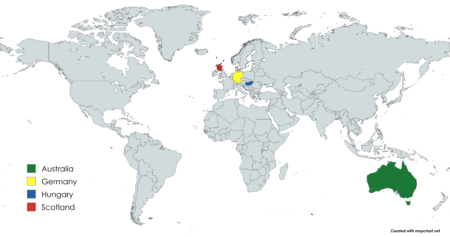
My academic path has been a bit like a global treasure hunt, except the treasure is usually lab equipment and plane tickets.
Budapest (ELTE): I wrapped up my Master’s in Physical Geography.
Glasgow: I moved here with almost no English, which made Scottish taxi rides feel like linguistic free climbing. I began volunteering at the Scottish Universities Environmental Research Centre, then worked in a luminescence lab under physicist David Sanderson. Working “from dawn till dusk” in a darkroom with hydrofluoric acid was character-building. But it opened the door to my PhD at the University of Glasgow, where I kept working with hydrofluoric acid, high temperatures, and liquid nitrogen.
Cologne: Postdoc years at Universität zu Köln with Tibor Dunai and Janet Rethemeyer included a detour into conventional radiocarbon dating (from old-fashioned scintillators to the cutting edge Automated Graphitization Equipment (AGE) system by IonPlus Ag). I also learned that Carnival is both a festival and an endurance sport.
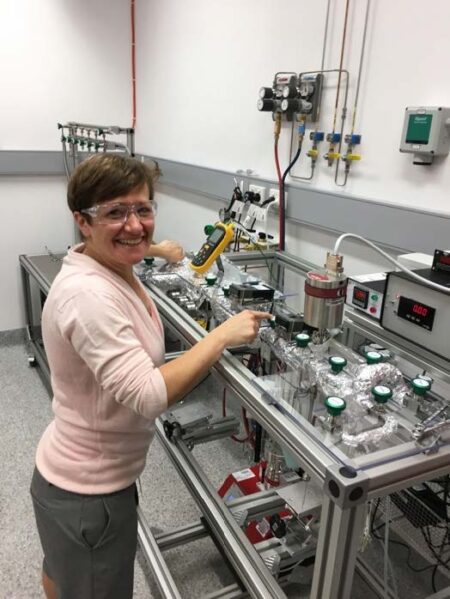
Sydney: I arrived for personal reasons in 2013 and, after several postdocs at the University of Wollongong, landed at ANSTO (Australia’s Nuclear Science and Technology Organisation) in 2020, where I now manage the in-situ C-14 lab and contribute to the Be-10/Al-26 programs and Accelerator Mass Spectrometer measurements.
Every move has enriched my life scientifically, personally, and culturally. I gained colleagues, mentors, and friends, as well as an appreciation for contrasts: Friday pub nights in Glasgow, Carnival chaos in Cologne, and the Australian love for barbecues, deadly animals, and the endless possibilities of wild weather. Of course, there’s the less glamorous side: moving countries drains both your wallet and your patience. And you don’t really grasp how far Australia is until you try to schedule a Zoom call with Europe.
Lessons Learned from Living Abroad
- Patience is a virtue. Integration takes time, celebrate small wins.
- Keep your network alive. Don’t vanish on old colleagues, one day you’ll need them.
- Pride beats perfection. Be proud of the leap, even if the landing is bumpy.
The Two-Body Problem
Academia is a bit like Tinder: you often meet your partner in the lab because your work is your hobby. But here’s the catch, two jobs in the same field, at the same institute, in the same city? That’s rarer than a Popperian black swan sighting. For couples in academia, the future can be complicated, especially with children in the mix. My advice? Think beyond the five-year horizon and be realistic about the opportunities and sacrifices required.
Advice for Aspiring Geochemists on the Move
- Move around! Each institute teaches you new skills, new technologies, and new ways of thinking.
- Do your paperwork early, bureaucracy is a slow beast.
- Be prepared: transitions cost time, money, and sometimes sanity.
- It’s normal to feel isolated at first, it doesn’t mean you made the wrong choice.
What I Love About My Work

During my PhD, my soil erosion project using in-situ C-14 felt impossible, the blanks were too high and reproducibility too low. I spent years refining methods, and now I can finally do the projects I once only dreamed of. The in-situ C-14 method still carries larger uncertainties than its isotope “siblings,” but every year we’re inching closer to consensus. I enjoy all aspects of my work, fieldwork, lab analysis, AMS (Accelerator Mass Spectrometry) measurements, data crunching. Pushing the limits of a method is my sweet spot. Science, to me, is about balance: between sample collection and analysis, laboratory and fieldwork, certainty and risk.
Training and Mentorship
I’ve co-supervised PhD students (with mixed success, sometimes life interrupts a thesis). More regularly, I support Australian Institute of Nuclear Science and Engineering (AINSE) students in my lab. My goal is to spark excitement for cosmogenic nuclides and give them meaningful, hands-on experiences. And while I’ve been lucky to receive wisdom from my mentors, I’m still learning how best to pass that on to the next generation.
Fieldwork Adventures
Fieldwork has taken me to Siberia, Namibia, Australia’s remote nooks, Ireland, Scotland, and Mexico. Collecting samples in remote, breathtaking (and occasionally snake-infested) landscapes is irreplaceable, it makes the numbers in the lab more meaningful. My most unforgettable fieldtrip was in the Kimberley: sitting atop million-year-old escarpments, sky pure blue, silence so deep it roared (except maybe for the venomous snakes underfoot). Meeting Aboriginal communities there also reminded me of what science sometimes forgets, our deep, human connection to land and culture.

Health and Work

Being a woman in science means balancing unique challenges. Pregnancy, childcare, and the physical realities of being a primary carer reshape work patterns. Academia still struggles to accommodate these shifts, and adaptation is often personal rather than institutional. In a foreign country (and in Australia’s case, a very distant one), the absence of an affordable support network or nearby family can make those moments when you most need a breath of air especially difficult. And the other way around, when your family needs you, it is almost impossible to travel there in time.
Community and Inclusion
I value the involvement of local and Indigenous students and have worked to support their participation in projects. While some initiatives are still a work in progress, the effort itself is important. It’s an ongoing process of learning, trying, and improving.
Interview conducted by the EAG Communications Committee