
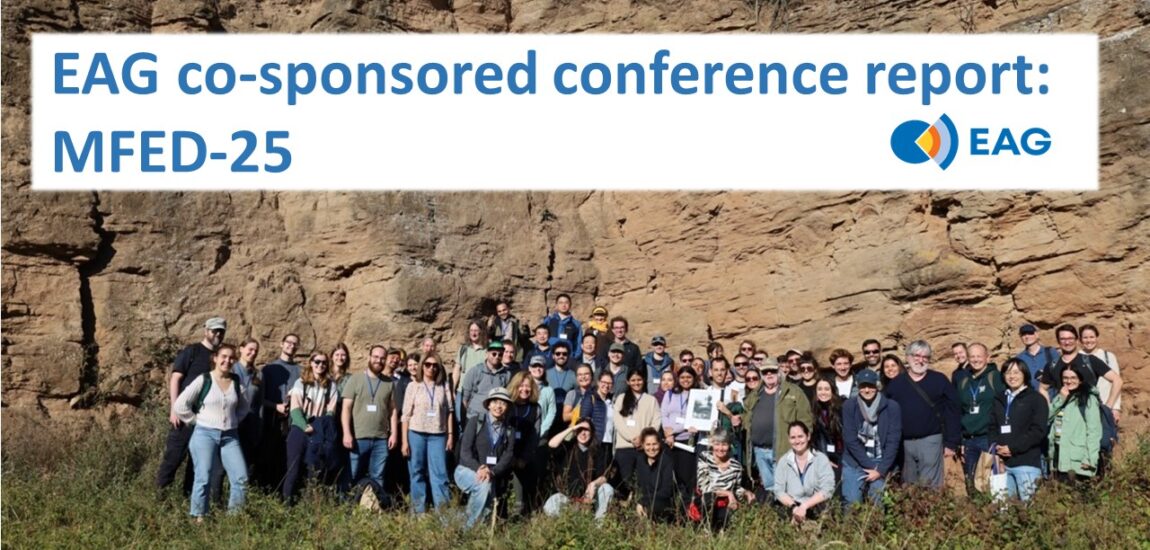
EAG co-sponsored conference report – Microbialites: Formation, Evolution, Diagenesis 2025
From 30th September to 3rd October 2025, about 100 in-person and 20 online participants from around the globe gathered in Hannover, Germany, for the M-FED25 (microbialites, formation, evolution, & diagenesis) conference to discuss the latest advances in the biology, sedimentology, biogeochemistry, and morphology of biofilms and their lithified counterparts.
One EAG-sponsored attendee, responds to: Why did you attend the MFED25 conference?
“I attended the conference because it is highly relevant to my field of study and professional interests. The lectures delivered by keynote speakers and talks provide valuable insights and up to date knowledge that are essential for my academic and professional development.”
Another responds to: Why did you attend the MFED25 conference?
“I study modern microbialites in South Africa. The conference theme was of huge interest to me, and I wanted to network with other researchers in this space and get a sense for the scope of research at present. I was also eager to see how our work might dovetail with some of that happening globally.“

The meeting, jointly organized by Dr. Sebastian Viehmann from Leibniz University Hannover and Dr. Simon V. Hohl from Tongji University Shanghai, began with an icebreaker party on the Tuesday evening, followed by sessions over the following three days on:
- (Bio)geosciences of biofilms and their interactions with the environment;
- Microbialites through deep time: unique archives for environmental reconstructions;
- Microbialites in varied geological settings: from continents to the deep sea; and
- Mutual impacts of microbialite mineralogy and environment.
Additionally, workshops on database building, cultivating your own microbial mat, and screening geochemical data were offered.
One EAG-sponsored attendee, responds to: What have you enjoyed the most at the MFED25? I enjoyed the workshop and interactive sessions, as they provide practical learning experience and opportunity for active participation.
Another EAG-sponsored attendee, responds to: What have you enjoyed the most at the MFED25? I enjoyed meeting researchers working on similar projects to mine. I usually find myself explaining what microbialites are to those outside my area of study. But at this conference, I was able to deepen my understanding of the processes involved in forming organosedimentary structures alongside experts in this field.

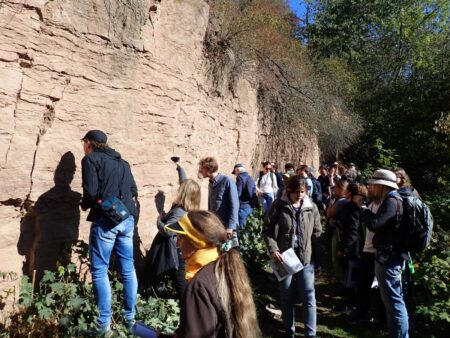
Finally, interested participants joined a fieldwork trip in excellent autumn weather to the nearby Heeseberg quarry, where they visited the Bernburg Formation, in which Ernst Kalkowsky described stromatolites as bio-sedimentary structures for the first time more than a hundred years ago.
One EAG sponsored participant responds to: from what have you benefited the most during the conference? For one part, I benefited from the networking. It is important to me to get to know people that are experts in the field I am working on, we can help each other, learn from each other and maybe even collaborate on scientific projects in the future. As the field of microbialites is highly interdisciplinary, I had the chance to meet scientists from various fields, which helped me explore how I might incorporate different approaches into my project.
Another EAG sponsored participant responds to: from what have you benefited the most during the conference? Networking and ideas – it was great to interact with the community whose papers I’ve read so many of, and hear from others what they thought of my work, and what type of work they’re doing that might be applied to our context in South Africa. A really rewarding conference! And a huge thanks to the organisers and funders – truly appreciated.


The event attracted many young scientists, fourteen of whom generously received financial supporting grants from the European Association of Geochemistry. The organizers and the young scientists thank the EAG for its support. At the end of the meeting, the community agreed to hold the next M-FED27 in Madrid, Spain. We excitedly look forward to welcoming researchers from diverse fields interested in microbialites.
Simon V. Hohl & Sebastian Viehmann