

EAG Early Career Science Ambassador Pim Kaskes travels to GSA Connects 2024

I am sincerely grateful to the European Association of Geochemistry (EAG) for granting me Early Career Science Ambassador support to attend the Geological Society of America (GSA) Annual Meeting 2024 in Anaheim, USA. This conference took place between 22 and 25 September 2024, and was an extraordinary experience for me, filled with enriching academic and professional opportunities.
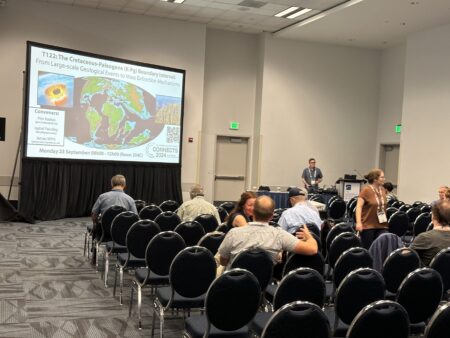
I had the honor of convening a session titled “T122. The Cretaceous-Paleogene (K-Pg) Boundary Interval: From Large-scale Geological Events to Mass Extinction Mechanisms”. This session, which I convened together with Dr. James Witts (Natural History Museum London, UK) and Dr. Isabel Fendley (Penn State University, USA) brought together a diverse group of scientists, including stratigraphers, geochronologists, paleontologists, geochemists, volcanologists, and modelers, to share their latest research findings. The discussions focused on the Chicxulub impact event, the Deccan Traps volcanism, and their role in the profound environmental and biological changes that occurred ~66 million years ago. These topics all aligned perfectly with my postdoctoral project at the Université libre de Bruxelles. The interdisciplinary approach of the session fostered dynamic discussions, enhancing our understanding of one of Earth’s most significant mass extinction events.
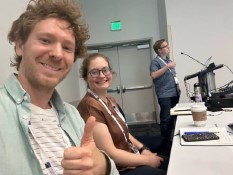
Beside sharing my research in two oral presentations, the GSA meeting also provided exceptional networking opportunities. I had the privilege to meet and engage with leading experts such as Prof. Brian Huber and Prof. Sean Gulick and early-career researchers in K-Pg boundary research and related fields such as Dr. Vicente Gilabert and Dr. Tushar Mittal. These interactions have opened avenues for potential collaborations and postdoctoral research opportunities. The lively exchanges during the sessions, poster presentations, and informal gatherings were invaluable in broadening my professional network and refining my research goals. I would like to express my deepest gratitude to EAG for supporting my participation in this prestigious event by covering a large part of my travel and accommodation costs. This funding made it possible for me to share my work, gain exposure to groundbreaking research, and advance my academic career right after my PhD. This experience will undoubtedly have a lasting impact on my professional development, and I am eager to apply the insights and connections gained to future projects.
About the Author
